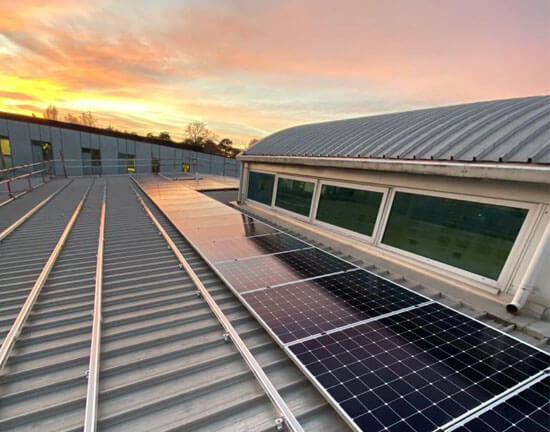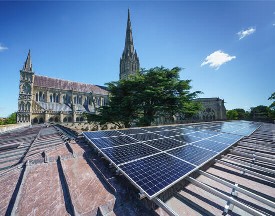


Roof with solar panels on

Bringing solar power to Latcham


Key highlights

  • A 567 kWp system with 1,276 panels
  • Generating 465,000 kWh every year
  • Saving 96 tonnes of CO2 annually

‘Businesses expend more energy than an individual, so they have to take the lead in tackling the climate crisis’, says Latcham’s Managing Director, Mike Hughes. Data, print, digital and fulfilment specialists, Latcham, are certainly doing that with their commitment to a sustainable approach.


Making sustainable change

Latcham has aligned its green goals with Bristol City Council, to be carbon neutral by 2030. To achieve their ambitions, Latcham is making a number of changes to the way they do business. These include recycling 94% of all waste materials to date, insulating walls, replacing windows, upgrading their print facility, installing EV charge points, and partnering with the Bristol charity, Tree Aid.

When they decided that solar energy would be part of this change, we were delighted to work with the Bristol Energy Cooperative to make it happen. Bristol Energy Cooperative offer free solar PV for businesses, schools and community organisations across Bristol, partnering with sites in or around the city which have large roofs and use lots of electricity.


Let’s go solar!

Latcham’s Bristol head office is a fantastic site to work on with its large, well-appointed roof. The initial challenge was maximising the number of panels on the main roof, and we did that with a combination of landscape and portrait design, to get as much on as possible. We also had to make sure the panels would be accessible for maintenance and cleaning, so that influenced our thinking.


The kit

We installed a 567 kWp system with 1,276 JA Solar fully traceable 445w panels. The system is connected to four 100 kW Solis inverters, which are mounted on a custom-built inverter frame.

The solar is predicted to generate 465,000 kWh every year, saving 96 tonnes of CO2 annually.


The dream

Latcham says that when it comes to the communications they create, “green is our dream”. We are so pleased to have helped them on the way to achieving this dream, in partnership with the brilliant Bristol Energy Cooperative.


Discover more

Read more about the solar we installed on the Castle Climbing Centre

Find out more about the award-winning solar we’ve installed on schools and community buildings in North Lincolnshire

Discover more about how we work with businesses to help them go solar

Read more about how we are involved in Community energy


King of the Castle – Castle Climbing Centre goes solar


Project highlights 

  • Solar array designed and installed on one of the most unique climbing centres in the world
  • 31.15kWp system
  • Generating 27,313kWh every year
  • Saving 5.66 tonnes of CO2 annually


Background

Housed within a former Victorian water pumping station in London, the Castle Climbing Centre offers climbing for people of all abilities…  from absolute beginners to those at the top of their game.

Talking of the top, our interest was in the roof! Our team was tasked with designing and installing a rooftop solar PV system to cut carbon, help reduce energy bills, and deliver greater energy independence. The aim was to power the majority of the business through solar energy, in keeping with the Castle’s goal of become a net-zero business. As they say:

“Sustainability is in our DNA. Our planet is precious, and as climbers we have a duty to protect it”. 


The building

Well, it’s not every day you install solar on a former Victorian water pumping station! Dating from the 1850s, it’s a grade II* listed building too.

We’re highly experienced in installing solar on heritage buildings (our award-winning install on Salisbury Cathedral is one to check out), so we relished the opportunity.


The challenges

Our challenges involved meeting the energy demands of the building, designing around shading of the array, and the system being visually in keeping with the building aesthetics. On top of that, we had an interesting, pitched roof construction to contend with.

We used Nicholson roof products to provide a strong, completely watertight fixing point to build the system up from. A Renusol VarioSole+ rail system was incorporated and we installed 70 JA Solar 445W panels.


The results

The system is predicted to generate 27,313kWh per year, with an annual carbon saving of 5.66 tonnes. Plus, the solar looks totally at home up on the historic roof. It’s the perfect addition to compliment their innovative ventilation system, 1.4 hectare organic permaculture garden, and a building that has been using 100% green energy since 2018.

We’ve loved helping the Castle Climbing Centre on their way to becoming a net-zero business and reach even greater heights when it comes to sustainability.


Discover more

Read more of our commercial solar case studies

Discover how we can help businesses with solar, battery storage, and EV charging infrastructure

Contact us to discuss your project. We’d love to help you.

Joju Solar installation on Bridport Leisure Centre

Swimming with Solar – Bridport Leisure Centre

Let’s talk installing solar on Leisure Centres… in particular, in Bridport.

Bridport Leisure Centre is a non-profit making, busy, community recreational hub, offering a wide range of activities for local people. These include a swimming pool, fitness classes, gym, squash, sports hall, yoga and kids activities.

How is it all powered? Well, the Centre was keen to explore having solar to help generate the energy required. This way, they could save on their energy bills and reduce their carbon footprint at the same time. We were only too pleased to help make this happen, of course.

Community-funded, community-owned

Initially, our Joju team created designs and costings for the site. Following funding discussions, we brought our good friends and colleagues at Energy 4 All on board. They look at how much power the system is going to generate and how much of it will be used on site by the Leisure Centre. Then, with funds from local community investors purchasing shares in the system, they pay for the project in its entirety. They maintain it, and buy the electricity that’s produced and consumed on site, at an agreed rate. The ownership of the system is then in the hands of local people, for the benefit of the local community.

On the roofs…

The installation took our Joju Solar team just under two weeks to complete, and all whilst keeping the Centre fully operational. That’s something we pride ourselves on and we know just how important it is to make sure any potentially disruptive work is carried out ‘out of hours’.

We installed 184 Canadian Solar 410W panels in total, and the install is actually split into two systems. 147 of the panels make up a system of just over 60 kWp. That’s on the main roof, above the swimming pool… hence our Swimming with solar headline! The smaller system of 37 panels, just over 15kWp, is on the rugby clubhouse roof.

The savings

Estimated CO2 savings work out at approx. 15.73 tonnes per year, with an annual estimated generation of 61,535 kWh, which will really help to power community wellbeing.

The reaction

The team at Bridport & West Dorset Sports Trust Ltd, and at the Centre itself, is really happy with the install and how the panels are looking.

The overall aim of the organisation is to enhance the quality of life for the community, and the solar install certainly contributes to the ongoing fulfilment of that aim – from a clean air and sustainability point of view.

Discover more about solar on Leisure Centres

  • Read about the Swimming Pool Support Fund in our blog.
  • Find out more about community energy and potential funding for your Leisure Centre project.
  • Read our Xcel Leisure Centre case study, for more about another public sector Leisure Centre installation.

Mahindra – Racing forward with Workplace Charging


Mahindra Racing – the ‘Greenest Team in Motorsport’ – is a founding team competing in the ABB FIA Formula E World Championship. Formula E is the world’s first, all-electric street racing series and the closest, most competitive, and fastest-growing category in motorsport – but it’s more than just a race on track! It’s also the leading platform to test new technologies, drive development to the production line, and ultimately lead to more electric cars on the road. It helps to alter perceptions and accelerate the switch to electric too, in a bid to counteract the climate crisis and address the effects of air pollution.

Teams with an impeccable pedigree

Mahindra Racing has an impeccable pedigree. The team was crowned 2021’s Climate Champions at the end of the last ABB FIA Formula E season and was the first Formula E team (and only the second motorsport outfit in the world) to receive the top Three-Star FIA Sustainability Accreditation. The team also became the first FIA World Championship entrant to be certified as Net Zero Carbon Footprint from inception, and we were delighted when the business approached our own impeccable team, to help with their workplace charging requirements at their new UK headquarters in Banbury.

Clarifying requirements, technology, and funding

Mahindra wanted to make EV charging available to all staff and visitors, as well as to encourage the uptake of electrical vehicles. The need was an initial 6 chargers to cover current and short to medium term demand, with the view to expanding in future, and one of the reasons they selected Joju was that they also wanted to explore potential for roof top solar for their Banbury site, to help further decrease the carbon footprint of their premises.

At Joju, we are highly experienced in helping our workplace EV charging customers navigate the variety of funding options available. In Mahindra’s case, as the site and business were eligible for the OZEV Workplace Charging Scheme, we were able to administer this on their behalf to secure a £350 per socket contribution to the cost of the install.

Also, due to being technology agnostic as a business, we were able to recommend the best solution for the site, as well as for our client’s brand goals. As ABB is the principal sponsor of the Formula E Championship, the link to the product on this commercial site was a natural one. Together we examined the ABB product range and agreed the best products for the application – namely the ABB Terra AC 22kW Wallbox chargers. The ABB back-office solution also provides the perfect functionality for Mahindra Racing to monitor their use.

The installation

We carried out the full turnkey installation including all groundworks, installation of the EV charge points on posts, the electrical installation, testing and commissioning, all to the required client timescales.

We pride ourselves on our dedicated project management, technical expertise and flexibility and for Mahindra, we needed to ensure we connected into the existing electrical infrastructure on site, choosing the correct supply chain partner and making sure this happened at a convenient ‘out of hours’ timeframe for the client.

The reaction

Dilbagh Gill, Team Principal and CEO at Mahinda Racing said,

“We believe that ‘doing good’ goes beyond philanthropy and CSR. It is more than just random acts of kindness. It is a purpose, an attitude, and a way of life. As a team, we are committed to finding credible, advanced and next generation mobility solutions while being kind to the planet. Sustainability is not a buzz word for us; it is ingrained into our ethos and a big part of the reason we are racing in Formula E.

The installation of EV charging points at our facility here in Banbury is yet another step in our journey to drive this change towards electrification and it has been a pleasure to work with Joju, whose reputation and attitude aligns so well with our own passion. We are grateful for their guidance every step of the way, and look forward to their continued support as we continue to grow”.

It’s always great to get this kind of feedback and we look forward to working with Mahindra Racing in the future, to keep their workplace charging goals on track!

Discover more

Bluebell railway, EV charge points, electric vehicles, ev charge point install, ev infrastructure

Bluebell Railway’s EV journey

Imagine travelling through eleven miles of scenic Sussex countryside on a steam train, meeting railway staff in period clothing, learning all about the history and science of the industrial age in an interactive museum, seeing original working signal boxes… and charging your EV whilst you do it! Well, now you can do exactly that at Bluebell Railway, one of the first preserved heritage lines in the country, as historic and contemporary travel infrastructure sits side by side.

Making it happen

Heritage Railways, with their vintage steam locomotives, may not be the first organisation that comes to mind when considering the green agenda, but the Bluebell Railway team decided to look to the future as well. They wanted to offer visitors, staff, and the local community the opportunity to charge their electric vehicles on site. To make it happen, they dedicated part of a recently received grant from the Department of Culture, Media & Science and got in touch with us to help them.

Steaming ahead!

We initially surveyed two sites, helping the team navigate the options based on what they wanted the charge points to deliver for the variety of people using them. Another consideration was making sure EV charging would be in place to welcome visitors by the time the railway reopened, following the lifting of Covid restrictions. The install was therefore completed by the beginning of April, 2021.

We selected 7kw Alfen chargers to fit with the electrical capacity available and were able to connect to existing onsite infrastructure, with enough spare capacity to meet the demands of all charge points should they be used simultaneously. This isn’t always the case and if capacity is limited, we also have solutions to allocate available power between charge points.

Here, two dual socket units were installed, allowing four cars to be charged in the upper car park at Sheffield Park station… home to the railway, interactive museum, picnic areas and shop. This included a designated charge point for blue badge holders, and the opportunity was also taken to remark the car park during the work.

The EV charge points are operated by our partners New Motion, with Bluebell Railway selecting this particular network for accessibility, and to service as many EV drivers as possible.

An electric future

Sheffield Park was built in 1882 by the London Brighton and South Coast Railway and it’s exciting to see that electric vehicles are now part of its historic story.

The Railway’s project manager said “JoJu Charging is an easy company to deal with and always makes that extra effort in customer satisfaction, which is good to receive”.

Find out more


S Georges' SPorts Centre, Scott Brown Rigg, Architects

St George’s College Iconic Solar Sports Hall

St George’s is an independent mixed Roman Catholic co-educational day school in Weybridge Surrey. The school have recently constructed a new Sports Hall for the school as their existing sports hall was only sized for 500 students (all boys).  The new sport hall now caters for over 1000 pupils (both boys and girls) over a wide range of sporting activities.

The new hall is a flagship architectural building, designed by Scott Brown Rigg Architects, with many unique design features that required careful integration of the solar PV.

The structure of the building is made from curved glulam columns and roof beams, which support a plywood deck.  Above the roof sites 150mm insulation, finished with a Sika Sarnafil single-ply roof membrane.  The roof is curved in two directions much like the Olympic Park velodrome, and also features diamond-shaped roof ventilation towers.

Careful Integration of Solar

As such, the design needed to account for the following sensitivities:

  1. As a high-end architectural project, aesthetics were paramount to the client.
  2. The installation mounting system needed to work with the curved surface of the roof.
  3. We needed to avoid shade from the ventilation towers.
  4. The chosen system needed to be lightweight so as not to compress the insulation, or led to puddling of water
  5. The system needed to be non-penetrative
  6. We needed to install sufficient solar PV to meet overall building CO2 targets.

The building carbon targets implied the building had a target of 32kWp of solar PV to generate 29,688kWh of electricity per year.  To meet this brief, we installed a system of 119 JA Solar 270W modules, connected to a single Solis 30kW inverter.


Sika SSM1 mounting system

Joju Solar are the solar energy partners of Sika Sarnafil who manufactured the roof membrane system.  Working closely with them and the main roofing contractors, Malone Roofing, we designed and delivered what we to believe to be a prime example of sensitive architectural integration of a commercial solar PV roof.

The chosen mounting system was the Sika Solar Mount SSM1, which offers several unique features, ideal for this project.  The mounting system consists of plastic triangular frames pitched at 15 degrees.  These frames use rubber fixing flaps, that sit over the frames which are then rubber-welded directly to the roof membrane.  Because the frames are bonded to the roof surface, the system is ballast-free, and therefore very lightweight.  This not only simplifies construction but helps from a structural engineering point of view, especially in case such as this where the span of the roof is large.  It also prevents compression of the insulation layer and puddling of water on the roof.

Uniquely, the mounting system and the roof membrane itself are covered under a single point warranty.  As Sam Rogan, Sika Sarnafil Technical Advisor explains: “The SikaSolar system offers a low profile panel with high output,  that is fully compatible with Sarnafil single ply roofing membranes”.  This avoids any potential conflict between the multiple contractors on-site, as there is a single holder of risk and responsibility.

Primarily designed for flat roofs, the SSM1 is limited to being installed on roofs of less than a 10-degree pitch.  We therefore restricted our array to those unshaded areas of the roof that met this design requirement.  The area chosen was such that optimisers were not required and the system could be strung on a single 30kW inverter.

As a further step to enhance the aesthetics of the installation, the DC cable routes were laid in channels cut into the insulation membrane, which were then covered with the main roofing membrane.  This removed the need for an unsightly cable tray running across the roof and preserved the clean aesthetics of the building.


(Images 1&3 courtesy of Scott Brown Rigg Architects)

Find Out More

  • Our PV design team is on hand to help you realise the solar part of any new build project, large or small
  • We have even integrated a bespoke solar PV array into the roof of Salisbury Cathedral
  • Solar schools like St George’s are a speciality of ours – find out more about the hundreds of solar schools we’ve already built
Oxford Brookes, Sunset, Solar PAnels, Salix Finance

A Hub of High Efficiency at Oxford Brookes University

Oxford Brookes is one of the UK’s leading modern universities with an international reputation for teaching innovation and excellence. They are also in the top tier of universities leading the way when it comes to limiting their effect on the environment*. Their 35% reduction in carbon emissions since 2005, already puts the university ahead of its 2025 target of a 34% reduction, but this hasn’t stopped Oxford Brookes wanting to push on and do more – to continue to reduce its environmental impact and create a student campus that truly supports sustainability, as well as inspiring students to significantly reduce wasted energy use and carbon emissions.


Funding and Fusion 21

When Oxford Brookes learned they could secure renawable energy project funding through Salix Finance (interest-free funding for the public sector to improve energy efficiency, reduce carbon emissions and lower energy bills), the university was keen to increase its existing solar PV capacity and looked into procurement routes to find the perfect solar PV partner.

They discovered Joju Solar through the Fusion 21 public sector procurement framework and after surveying the university site, we helped to identify five more suitable buildings for solar PV – designing and procuring the best possible system within Salix funding parameters. The project couldn’t cost more than £222 per tonne of carbon saved (over the lifetime of the project), with a project payback of 8 years.


A greater yield with SunPower

As Oxford Brookes University was committed to generating as much as possible in the available space, to “do more with less” and get the most value from existing building spaces, we used high efficiency SunPower modules on the Buckley Building, John Payne Building, Lloyd Building, Sinclair Building and the International Centre.

Although rare for a commercial solar panel installation project, these state-of-the-art panels gave Oxford Brookes greater output per square metre of roof space, adding just under 300kWp and doubling their solar PV capacity. From a cost perspective, this approach still worked within the Salix Finance funding model, so it was a winner all round!

Despite the installation being initially postponed due to Covid19, the 700 solar panels were installed in November 2020 and it was an absolute pleasure working with Oxford Brookes University to extend their visible commitment to a low carbon future by creating a high efficiency array – generating 224,912kWh per year, with a 57 tonnes CO2 saving.


Discover more

  • We love working in the education sector and Solar schools is one of our specialities.  We can deliver fully funded installations across your school or university estate, so do find out more about our solar for schools and education
  • Discover more about Solar PV and how we can help you.
  • SunPower modules are the state of the art – offering efficiencies of more than 23%.
Noah'sArk, Green roof, biosolar, aerial, BArnet

A Biosolar Roof for Noah’s Ark

Noah’s Ark Children’s Hospice make moments matter. They help seriously unwell babies, children and their families make the most of the special time they have together, providing clinical, emotional and practical support to over 300 families across North and Central London and Hertsmere.


The hospice wanted to support an increase in the scale and quality of their work and to do that, they needed a new building. ‘The Ark’, a highly sustainable ‘home-from-home’ and an inspiring space for palliative care, relaxation and adventure, launched in September 2019 and was constructed within their nature reserve in Barnet, becoming the first new hospice building in London for ten years.


The realisation of The Ark was a combination of an incredibly successful fundraising appeal which raised over £12million, architectural design by Squire & Partners and collaboration between a number of construction and sustainability professionals – all playing their part to create this iconic new build. At Joju Solar, we got involved when creating ‘a green roof with a difference’ became part of the plan.


A Green roof with added solar

Bridgman & Bridgman in partnership with Bauder Ltd began the construction of The Ark’s green roof and the idea was to create a living, wildflower meadow in the sky, to support native wildlife as part of the building’s strong connection with its natural setting.


It was also important to make The Ark as self-sufficient as possible from an energy perspective, which meant installing solar PV on the green roof. The solar was being funded by the community through Energy 4 All, which significantly reduced the overall capital expenditure of the project (saving over £84,000 in energy costs to the client over a 20-year period). We’ve worked closely with Energy 4 All on a number of community-owned, green energy projects and they invited us to be part of the team – to install 171 solar PV panels so that both green roof and solar worked together in harmony.


When installed correctly, that’s exactly what Biosolar roofs create. PV panels can work more efficiently on a green roof, as green roofs help to keep the temperature around the panels at the optimum 25 degrees celsius. A hotter micro climate can result in loss of panel efficiency, so green roof and solar is the perfect partnership from that perspective. Efficiency was critical in this very special new build, to make sure the hospice would receive as greater yield as possible.


Solar panels can also create shaded areas underneath them, which encourages a wider variety of vegetation to grow on a green roof. That means the combination can help different types of species to thrive and in a nature reserve setting, this worked beautifully.  Look how the wind protection allows taller species to grow near the panels!


The installation utilised Bauder BioSOLAR – an integrated mounting system made stable by green roof layering and vegetation, removing the need for penetrating the waterproofing to secure the mounting units to the roof. It was ready for us to install the solar panels on to, with the frame sitting around 300mm higher than the line of the roof. This allowed growing room for vegetation without blocking any light to the panels and also meant light and moisture could reach beneath them to support any vegetation or wildlife below.


The seeds were planted following our PV solar install and once the mains electricity install was complete, we returned to commission the 46.17kWp system.


Green roof and solar – a winning combination

The combination of green roof and solar on The Ark was a winning one. Not only did it encourage biodiversity and fulfil the goal of generating the building’s electricity, the project won the “Roof Gardens/ Living Wall Installations – Commercial Roof Garden or Podium Landscaping – Under £500k” award in the BALI National Landscape Awards 2020. It’s also the first time a community funded green roof with PV panels has been used in the UK.


As the Mayor of London, Sadiq Khan, said when the building opened:

“Noah’s Ark has been a beacon of light for the children and families it serves, so I’m delighted that they have a brand-new home,”

and we’re proud to have been able to play a small part in helping to make this peaceful sanctuary sustainable.

Discover more


Egni Coop, Graint Thomas Velodrome, Newport Councl, largest solar roof in Wales,

Egni Coop’s Welsh Community Solar Programme

Egni Coop and Joju Solar have developed and installed the most ambitious community solar scheme in Wales, including the largest single community solar rooftop at Newport’s Geraint Thomas velodrome. It’s quite a story – here’s how we did it.

READ MORE

Salisbury Cathedral, solar, spire

The Salisbury Cathedral Solar Roof

How did a small local community energy group end up building one of the most iconic renewable energy projects in the UK?  Well, it turns out dedication, perseverance, and a little good fortune are all you need.

Salisbury Community Energy

Salisbury Community Energy is a relatively new community energy group.  They were formed in 2017 by a group of Salisbury residents who were trying to address climate change within their local area.  Director Caroline Lanyon explains “When we started we had a simple question: how can we get more renewable energy in Salisbury?”

From small beginnings …

In their early years, Salisbury Community Energy looked at a wide range of possible projects, and all possible renewable energy technologies.  They finally settled on developing a solar power portfolio, as potential hydropower schemes on rivers in the City looked complex due to Environment Agency concerns about the flood plain, and potential opposition from local anglers.

The group started scoping out a portfolio of solar PV projects in Salisbury, mainly on local schools, but with other large community buildings also considered.

Solar on Salisbury Cathedral?

Almost inevitably, someone suggested that the group should approach Salisbury Cathedral about the possibility of installing solar panels there.  However, the group didn’t expect much of a response.  “Local environmental groups had been pushing for the development of a solar array on the Cathedral since the 1990s”, said Caroline “But they’d always been refused”.

But as a new group, Salisbury Community Energy thought it was worth a shot, and they decided to try the door one last time.  To their surprise, it opened!

The Planning Process for Solar on churches

Canon Treasurer Robert Titley from Salisbury Cathedral was instrumental in making the scheme happen. As a local community group, Salisbury Community Energy found a receptive ear as Robert was already implementing a range of green initiatives across the Cathedral, including draft-proofing the medieval building, moving to a green tariff energy and installing LED lighting.  His faith and environmental vision went hand in hand.  “We are called to preach good news, and through this we are taking another small step toward being good news for God’s earth and not just part of the problem”.  Solar panels were an obvious next step, and the idea of a high-profile project appealed.  “It’s important to send a message to the rest of the city”, he added.

At around the same time, the Rt Rev Nicholas Holtam, Bishop of Salisbury was appointed the Church of England’s lead bishop for the environment.  He has recently signed a letter to the Government asking for the environment to be part of its post-COVID-19 plans.  He was naturally fully supportive of the idea of putting solar panels on the Cathedral.

However, before the project could happen, the proposal needed to pass through ecclesiastical planning.  Town planning rules cover development on most churches and local council planning departments adjudicate on them.  But as a Cathedral, especially a unique historical one, the proposals had to pass the scrutiny of church bodies instead.  As one might imagine, it is not an easy process to pass through the many internal committees.  They are very stringent, and rightly so – they do, after all, have a duty to protect these buildings of national importance.

Eventually, the scheme was approved, subject to specific design criteria being met:

  • The panels must not be visible from the ground, or higher ground in the Salisbury area
  • There must be no drilling into the historic structure of the building
  • There must be no damage to the lead roof covering

But just as the project was gaining traction – a new hurdle appeared.  The Government planned to remove feed-in tariffs in April 2019, leaving just months to get this project, and other schools in the portfolio pre-accredited.

The Salisbury Cathedral solar design team

Salisbury Community Energy approached Energy4All’s Schools’ Energy Coop for advice.  They had years of experience in pre-accrediting community energy sites. They agreed to help with early project development stages, such as gaining EPC certificates.  They also managed the financial raise for the scheme when it went eventually ahead.

And this is where Joju Solar joined the team!  As the long-term installation partners for the Schools’ Energy Coop, we were asked to come up with a design that met the ecclesiastic planning committees stringent design requirements.

The project team chose the cloister area for the solar panels. The panels are not visible from the ground, and there is a parapet wall surrounding them.  This helps keep the panels hidden from view but does give local shading issues.  The church left some dummy panels on top of the cloister roof for several months before the build to see if these would be visible from the surrounding area.  It turns out they weren’t!

Because no direct fixings were possible, we decided to use panels mounted on a ballasted frame.  As a roofing material, lead is quite unique in that it is soft, and it moves around a lot as it expands and contracts in the sun.  Clamping on to the ‘broom handle seams’ is not a possibility as it would soon cause a hole around the fixing points.

Joju decided to work with solar mounting system specialists Sunfixings on this project.  Sunfixings have extensive experience in designing solar PV mounting systems for lead roofs and were an obvious technology partner for this project.  The roof has a stepped surface, and is generally a little uneven and not quite straight (it turns out our laser lines are more accurate than 800 years old craftsmanship).  The design team settled on a fully adjustable frame to ensure there was good contact at the right places over the surface of the roof.

It’s not just the panels; of course, there is also the wiring to consider.  The cables were collected under the array, then ran in a discretely positioned basket tray, on rubber feet, following the line of the roof.  The wires ran to the new café and gift shop section, which as a modern extension meant we could finally drill a hole to get the cables to the inverter and consumer unit inside.

Salisbury Cathedral’s Solar Roof

The solar array was finally built on the Cathedral in July 2020, as soon as we were able to come out of lockdown safely.  The system features 37kW of high-efficiency Sunpower 400W modules.

The system was formally opened by The Bishop of Salisbury.  His words, perhaps best sum up the scheme:  “The Church of England is working hard towards a Net Zero carbon footprint by 2030. I am delighted that Salisbury Cathedral is making a contribution that takes us towards this. With clear purpose and helpful partnerships even iconic buildings can make a difference towards sustainability. In these strange times the possibilities of living differently seem all the more important and this project even more significant.”

So, was this iconic project all just a stroke of good luck?  Did it only get built because the community group approached clergy who happened to be passionate about the environment? And then chanced to meet other partners to help with the financial raise, project development, design, and build?

Or maybe we all make our own luck, and the more we try to make our visions a reality, the more likely we are to find others who feel the same way. And then great things can happen. We like to think so, and we expect to see more historic buildings sensitively incorporating solar over the coming years.


All photos by the sublime Ash Mills.

Find out more