In a week when Britain’s largest and ‘most advanced’ electric vehicle charging station officially opened its doors in Hampshire, Nissan announced the next 3 electric vehicles in its line up, and commentators have been in a frenzy over declining Tesla sales, it’s sometimes hard to know where to turn to for robust information on EVs.
The EV facts are out there though, because a campaign by Auto Trader, the National Franchised Dealers Association (NFDA), ChargeUK and the Society of Motor Manufacturers and Traders (SMMT), has been launched to combat misinformation.
It’s endorsed by the Department for Transport, and Zapmap is behind it as well.
Delivering the EV facts
The idea is to bring facts from trusted sources, on a variety of EV related topics, together in one place, so everyone knows where to go to get genuine information. The data is presented in an easy to digest format, and will be regularly reviewed and updated, with new versions issued when necessary.
Find the facts here
You can find the facts here, whether you are considering making the switch and doing your research, or simply looking for some sanity in the often confusing media narrative.
At Joju, we definitely welcome this collection of simplified facts, offering a balanced and data-backed view of the reality of owning and driving electric cars.
A new study shows Electric Vehicles now rival petrol cars in reliability and lifespan.
This is due to rapid advances in technology, according to researchers from The University of Birmingham, The London School of Economics and Political Science, The University of California San Diego and The University of Bern.

The study
Almost 300 million UK MOT test recordsfrom 2005-2022 were analysed by the team, allowing researchers to understand more about the longevity of different vehicles andthe lifespan of the vehicles main components (powertrains).
They concluded modern EV models last 18.4 years and travel 124,000 miles on average, and that rapid advances in technology now allow EV’s to have comparable lifespans with petrol vehicles, even under more intensive use.
Co-author of the study, Robert Elliot, Professor of Economics at the University of Birmingham said:
“ BEV’s offer significant environmental benefits, as Europe switches to a more renewable energy mix… a long-lasting electric vehicle can quickly offset its carbon footprint, contributing to the fight against climate change, making them a more sustainable long-term option”.
Co-author Dr Viet Nguyen, at the London School of Economics commented:
“BEV’s are a viable and sustainable alternative to traditional vehicles – a significant step towards achieving a net-zero carbon future”.
Reliable data to inspire policy change?
Professor Robert Elliot went on to say that as well as offering consumers reliable data to make an informed purchase, the research has an impact on policymakers too:
“Policymakers can use our insights to shape regulations and incentives that promote the adoption of durable and environmentally friendly vehicles, and plan ahead their end-of-life treatment”.
Want more?
You can explore the open access research “The closing longevity gap between battery electric vehicles and internal combustion vehicles in Great Britain”, here, in Nature Energy.
New year, new car? Well, if you’re thinking of switching to an electric vehicle in 2025 and joining the other 1.36 million EV drivers on UK roads, the good news is that the number of public charge points across the UK has increased by 38% year on year.
Zapmap, who help EV drivers search for EV chargers, plan longer journeys and pay for charging. has just released its 2024 year-end report… and it’s official! It’s been a record-breaking year for EV Charging Infrastructure growth.
The total stands at 73,699 available charge points and by the end of 2024, over 2.5 million successful charging sessions were recorded monthly. This paints a positive picture about the reliability of EV charging infrastructure too.
Ultra-rapids lead the charge
Ultra-rapid charge points (150kW+) cater for EV drivers looking for a quick charge on longer journeys, and installations are booming! They’ve increased by 84% in 2024 (compared with the end of 2023) according to Zapmap’s data. Figures show around 7,000 ultra-rapid chargers are available, with over 14,000 chargers exceeding 50kW.
Hubs are on the rise
The number of hubs with six or more 50kW chargers has also risen from 264 in 2023 to 537 at the end of 2024. As we know only too well from our own hub installation work, the days of hubs being confined to Motorway Service Stations are long gone! Hubs are being rolled out in public car parks, retail parks, farm shops, garden centres, and a variety of other public locations. We’re excited to bring more hubs online in 2025, so watch this space!
Destination charging continues to grow
Convenience has always been king, and destination charging is still growing. That’s good news if you want to charge whilst shopping, going to the gym, or incorporating charging into your daily routine when you’re out and about. Over 12,000 new chargers have been added at these kinds of destinations in 2024, and more will be on the way this year. As we always say, it’s all about matching the right charger to the right location
and we’re pleased to be part of making this a reality.
On-street charging expands
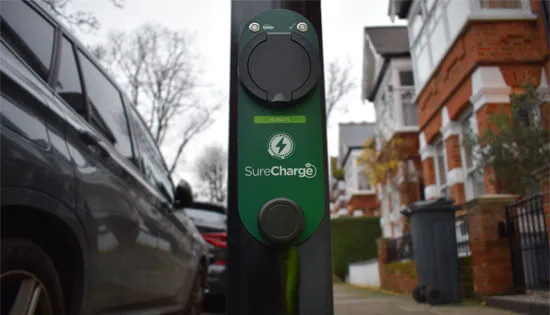
On-street charging helps drivers without access to off-street parking, charge their electric vehicle at home. The quantity of available chargers has risen, but with 72% of on-street chargers concentrated in Greater London, the coverage of charging does remain uneven. We have experience in installing on-street charge points in the Boroughs of Hammersmith and Fulham, Kingston, Merton, and in other locations around the country including Reading, Winchester and Portsmouth.
We’re hopeful that the Government’s Local Electric Vehicle Infrastructure fund (LEVI) will address the inequalities, as projects supporting by that funding begin to be installed this year. 2025 will hopefully be the year of achieving a more equitable distribution of charge points!
As Joju CEO, Joe Michaels, commented:
“Diversifying the EV Charging landscape and making EV Charging more equitable is certainly one of the biggest challenges the industry is facing. We’re hopeful that LEVI-funded projects reaching local areas will mean greater public access to charging infrastructure by the end of the year, and that PCPR Consumer regulations will also have an impact. Our focus is to help local authorities and other destinations install the right chargers in the right location, delivering the best possible EV Charging experience for EV drivers across the country.”
There’s definitely a surge in positive news about Electric Vehicles right now. The rising demand for EVs has given a huge boost to the used car market in the second quarter of 2024. Plus, a new report shows significant progress in getting EV Chargers in the ground and online.

Let’s unpick these latest developments a little.
Used EV market reaches record highs
The Society of Motor Manufacturers and Traders (SMMT) is reporting that sales of used battery electric vehicles haverisen by 52.6% year on year. With almost 46,800 transactions, this equates to a record quarterly market share of 2.4% – that’s up from the 1.7% share of last year.
EVs between 3-5 years old are selling the fastest, with a 138% sales increase year-on-year… and that’s not all. The predications are that by year end, electric car sales will have increased by 5% due to unprecedented demand.
What’s causing the increased EV uptake?
There are many reasons. EVs are cheaper to run, and the falling purchase cost of electric vehicles is a biggie! Technological advancements including improvements in battery power are making newer models more attractive, especially to early adopters of EVs. As they look to newer models, rapid drops in pricing of used electric vehicles attracts more people to the market. And, that 2030 deadline is looming, after all!
When it comes to pricing, the vehicle history check and valuation group HPI says the average price of a three-year-old used EV as 8.5% less than its fossil fuel counterpart. That makes it feel like a no-brainer to many.
According to HPI data, values of used EVs for cars at the same age and mileage point, have halved since September 2022, and you can discover more here.
Significant EV charging progress is underway
There’s good news if you’re looking for an EV Charge Point too! A report by net zero data consultancy Field Dynamics, Zapmap, and Ordnance Survey, highlights progress in installing EV charging infrastructure across Great Britain.
Average coverage across local authorities has increased from 17.2% in 2022 to 24.8% in 2024. The number of charger locations has also increased by 60%. In terms of geography, London is leading the way with 67% coverage of on-street households. That’s significantly higher than the national average of 20%. We’ve been installing on street charge points in the capital, and you can read more about it here.
Outside London, Brighton and Hove (83%), Coventry (76%), and Portsmouth (58%) are leading the charge.
Disparities in charge point coverage
The report shows that disparities do remain though, despite the progress, with 38 local authorities covering less than 10% of their on-street households. More needs to be done, of course, and we are primed and ready to help!
As our Head of Sales, Emma Blades, commented:
“It’s great to see such positive progress when it comes to the installation and operation of EV Charging Infrastructure. Installers, like ourselves, have been working hard to get more charge points in the ground, and online, alongside Charge Point Operators.
We should recognise though, that there are lots of reasons why it’s tricky for some local authorities to extend charge point coverage. It could be the challenge of rural locations, lack of allocated bays in densely-populated residential areas, the location of street furniture, and many other reasons why locations might not be suitable. Often it’s not for the want of trying, and logistical challenges make it difficult, but not impossible.
The government’s LEVI fund will help to make equity of charging more commonplace… and, when discussing the challenges and potential solutions with local authorities in our public sector knowledge sharing workshop, ‘EV Insights’, it’s clear that local authorities are committed to providing the necessary infrastructure. Solutions will be found, where possible, and we can be sure charge point numbers and locations will continue to grow for the benefit of all EV drivers”.
Back in February, a House of Lords enquiry found that the UK government must do more to counter the “misinformation” on electric vehicles, published in parts of the UK media. Fast forward a couple of months, and there’s still a consistent swirl of stories continuing to perpetuate certain myths about electric vehicles, including myths about battery life, pollution, range, and much more besides. This misinformation is also rife on social media.
Joju’s take
Joju Founder and CEO, Joe Michaels, thinks these inaccurate, often misleading stories are definitely having an impact on potential EV drivers:
“It’s making people slower to make decisions on transitioning from polluting fossil fuel vehicles, to cleaner vehicles . That’s the main problem, and people don’t know quite what to believe. I think it’s really important that people find a credible source of information”.
Joe goes on to say:
“There’s a huge market where it’s in their interest to create scepticism over the transition to electric vehicles and clean vehicles. It’s still a minority trying to explain why electric vehicles are better for the environment. You’re dealing with a David and Goliath situation still, and it’s quite easy for the fossil fuel market to swamp negative information about EV’s on to the market”.
Joe speaks more about the importance of fact checking in a recent interview, and you can listen to that, here:
Three resources busting the EV myths
The importance of having credible sources to refer to is essential, so whether you’re already an EV owner or you’re looking to make the switch to electric and want some myth busting information to get your facts straight, here are the top three places we recommend heading to for straight talking, factual info:
FairCharge’s little book of EV Myths
This recently published PDF might be small, but it packs a mighty punch, succinctly addressing some of the most embedded EV myths, using facts and data to set the record straight. EV batteries don’t last? Electric vehicles pollute more than petrol cars? Hydrogen will displace EV’s anyway? All these myths and more are debubnked in the little book. It’s completely free and you can download it here.
The Energy Saving Trust
A great source of always-impartial information is the Energy Saving Trust (EST). They have a dedicated section on their website debunking myths around electric vehicles, updated in February 2024. Head here for that one.
The Guardian EV Mythbusters series
One of the sources Joe refers to in his interview, is the series of articles in The Guardian, exploring the myths, the realities and the grey areas surrounding electric vehicles. It answers questions like, “Are electric cars too heavy for roads, bridges and car parks”? “Is it right to be worried about getting stranded in an electric car”? “Do electric cars pose a greater fire risk than petrol or diesel cars”? and lots more besides. Each article in the series covers the science associated with the topic and is a must for anyone wanting to find out more about the truth behind the claims. You can find the series here.
Let’s bust the EV myths and move forward with factual information that helps drive the change we want to see for our families, our friends, and our planet.
From Scotland to Hertfordshire and beyond,Joju’s Commercial Director and Co-Founder, Joe Michaels, discovers the answer in some unusual places and shares it with us this World EV Day.
You might remember that our Head of Delivery (EV Charging), Graeme Patton, recently got his first electric car. Well, we’ve been catching up with Graeme to find out about his experiences so far… from collecting the car from the dealership, to how he’s been finding the range. Plot spoiler: the word ‘planning’ comes up a lot!
This week, the EV Summit is celebrating Top Women in EV, with their event recognising the achievements of women in campaigns and policy, business, communications, marketing, engineering and technology, HR and business development.
We’ve got the lyrics from that particular Pulp song on a loop in our heads, because our Head of Delivery (EV Charging), Graeme Patton, has recently got his first EV. Over the next couple of months, we’re going to be finding out all about that experience and asking you to share your first EV experiences with us too – on our social channels, using the hashtag #firstEV.READ MORE
To provide the best experiences, we use technologies like cookies to store and/or access device information. Consenting to these technologies will allow us to process data such as browsing behaviour or unique IDs on this site. Not consenting or withdrawing consent, may adversely affect certain features and functions.
Functional
Always active
The technical storage or access is strictly necessary for the legitimate purpose of enabling the use of a specific service explicitly requested by the subscriber or user, or for the sole purpose of carrying out the transmission of a communication over an electronic communications network.
Preferences
The technical storage or access is necessary for the legitimate purpose of storing preferences that are not requested by the subscriber or user.
Statistics
The technical storage or access that is used exclusively for statistical purposes.The technical storage or access that is used exclusively for anonymous statistical purposes. Without a subpoena, voluntary compliance on the part of your Internet Service Provider, or additional records from a third party, information stored or retrieved for this purpose alone cannot usually be used to identify you.
Marketing
The technical storage or access is required to create user profiles to send advertising, or to track the user on a website or across several websites for similar marketing purposes.