


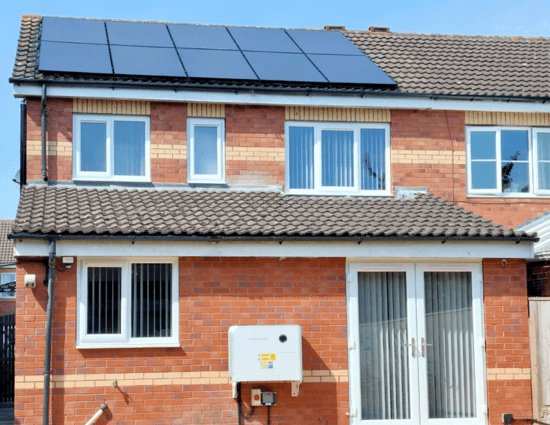
David’s solar double, and a battery first!
Just over two years ago, David contacted us to install solar on his London home. When the time came for him to sell up and make the move north, there was only one company he was going to call again… us!
We were delighted David came back to Joju, and only too pleased to help him with the design and install for his new northern pad.
First time round
Chatting about his first Joju install in London, David says:
“When I had panels installed, I did my homework. Joju had a very good report on Which and installing solar on my two up two down in Dagenham was the best thing I ever did. As batteries were subject to VAT then and my usage was low as a single occupier, I didn’t go with a battery at that time and that was the advice of the Joju surveyor.
I did benefit greatly from what I was generating during the day. I got my electricity bills down to an average of £12 a month (excluding the Standing Charge), and over the 2 years I made £1,000 under the Smart Export Guarantee (SEG) scheme. When I deducted what I paid in electricity from what I got in income, I was about £540 up and when I was selling the house, the people who bought it were very keen on this, and all the background data I had”.
New beginnings, solar, and a Sigenstor first!
Having already had solar panels in London, David definitely wanted to have them in his new home. As he says,
“My first, very positive experience with Joju made them my first choice to advise on, plan and install the system.
I do have a very strong view about climate change and looking forward, so in a sense money wasn’t the major driver for me this time round. It’s interesting to know the return you’re getting and how long it will take to recoup the costs, but I paid for it with the proceeds of the sale of my old house, so in a sense I’m very lucky that those calculations aren’t a huge issue for me.
Dan from Joju came to look at the house and we discussed what I wanted… to maximise the potential of the system. My new house faces east-west, the same as my London house did, and I wanted panels on the front and the back again. Dan said I could have up to 10 panels on each side, so we went for 20 in total. We talked about the kind of panels, and Dan recommended a panel made in Spain which was very highly rated in terms of efficiency. It was also a lot more cost effective this time.
We discussed a battery as the VAT has been removed, the technology has improved, and the overall costs have fallen since the last install. I was keen to explore alternatives to the market leader and so I became one of the first Joju installs of the Sigenstor battery. I was happy to go for it, and the unit cost of the battery was very reasonable. In terms of value for money, it was very competitive indeed”.
Installing the system
When the installation team got to work, David says:
“The team were very considerate and efficient. I was also able to liaise with a project co-ordinator who took personal responsibility for the management of the installation from beginning to end. The installation team fulfilled all their obligations in relation to time, the quality of the workmanship was excellent, and any questions I had were answered both courteously and in detail. They did an excellent job and the installation was absolutely trouble-free. I did also stock up the fridge with red bull for the install team!”
Of course, the team will always appreciate that! Thank you David.
System performance
When it comes to the system performance so far, again David is all smiles. He tells us that the Sigenergy app is easy to use and that there are already some very positive stats to share.
“Since the system has been commissioned, I’ve been entirely energy self-sufficient. The best day so far was August 10th. The panels were at a maximum efficiency of 97.13% which was very good, and the battery was fully charged to 8.05 kWh.
The stats show that the system generated 47.23 kWh of energy that day, of which 42.6kWh was exported to the grid. Total consumption was 4.62kWh so 1.39kWh came from the battery and the balance from the panels. 1.41 kWh went to charging the battery. I’m in the process of registering with Octopus and on my calculations, I would have been given anywhere between 4p per unit to 15p per unit depending on demand. I use quite a lot of appliances and the system comfortably supplies enough energy for them – even the kettle, microwave and hob together!”
Now that’s a great outcome!
As David says, it’s too early to predict an average return for a year, but on present performance he anticipates being self-sufficient throughout the annual cycle.
Would David recommend us?
“Oh absolutely”, says David. “In fact, I’ve already done it with my friends and family on Facebook”!
That is music to our ears, especially when David shares his reasons.
“The service, the quality of the workmanship, the attention to my own views, and the overall return from the system. There isn’t anything I would change or criticise. The new technology is paying dividends already, so I’m very very happy”.
We’re only ever as happy as our customers are, so it’s great to hear that David’s solar and Sigenstor system is working wonders.
System details
- 10 kWp PV
- 20 x Eurener 500 W panels evenly spread across two roofs (east-west)
- Bird protection
- Sigenergy Sigenstor system
- Sigenergy gateway provides home backup functionality
- 8 kW Sigenergy Energy Controller (inverter)
- 8 kWh Sigenergy battery
Further information
For more about the Sigenstor battery, take a listen to Dan sharing the features and benefits.
To discuss solar and battery storage for your home, please get in touch.
For more case studies, head here.
